Luma Waveform
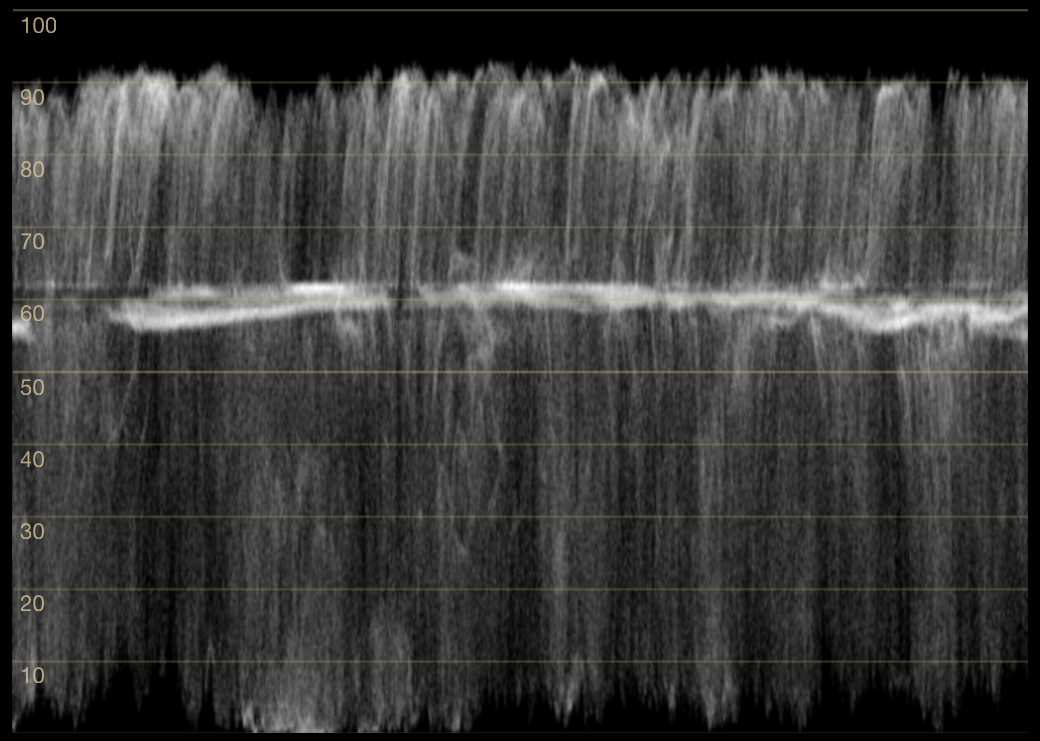
Luma Waveform preserves horizontal image position and plots a weighted sum of the captured R′G′B′ values.
What the trace represents
The horizontal axis follows the selected region from left to right. The vertical axis runs from 0 to 100 and represents full-range display-code level. Each sampled pixel contributes at the level calculated from its encoded red, green, and blue values.
SideScopes uses a Rec.709-style Y′ calculation:
Y′ ≈ 0.2126 R′ + 0.7152 G′ + 0.0722 B′
The prime marks matter. The calculation is performed on nonlinear, display-encoded values; it is not a measurement of physical luminance. It is also not a direct exposure meter. Exposure belongs to the capture and image pipeline, while SideScopes receives the rendered output at the screen.
What it is useful for
A luma waveform makes the distribution of rendered levels easy to locate in the image. It can show:
- where a bright or dark feature lies horizontally;
- whether rendered shadows or highlights approach an endpoint;
- how the tonal distribution changes across a frame;
- whether two outputs differ when measured through the same display path.
These are measurements of the output, not automatic judgments about it. A high-key image can correctly concentrate near the top; a silhouette can correctly reach the bottom. Delivery limits and intended contrast must come from the relevant workflow, not from the trace alone.
Endpoints and source latitude
Accumulation at 0 or 100 means captured pixels reached the corresponding display-code endpoint. It may be evidence of limiting in the rendered output, but it does not reveal which stage caused it or what the source still contains. A RAW processor, grading timeline, compositor, or source clip can retain data that is no longer distinguishable in the pixels presented to SideScopes.
Use the source application’s own scopes or controls when you need to inspect a pre-display signal, scene-referred values, HDR levels, or recoverable latitude.
Plain and colored styles
The Plain style draws a neutral trace. The Colored style uses the captured RGB contributions to tint the trace, providing spatial color context without turning it into three separate channel plots. The vertical coordinate remains the same luma calculation in both styles.
For channel relationships, use Waveform or RGB Parade.
Reference: ITU-R BT.709 defines the Rec.709 system and its encoded luma coefficients.